
Google Analytics 4 (GA4) is Google’s latest analytics platform, designed to help businesses understand user behavior across websites and apps in a privacy-focused digital world. It replaces Universal Analytics (UA) and introduces a completely new way of collecting, analyzing, and interpreting data. For modern digital marketing, GA4 is not optional it is essential.
With users moving across devices, platforms, and channels, GA4 provides a unified and future-ready measurement solution that aligns with how people actually interact online today.
What Is GA4 (Google Analytics 4)?
GA4 is the newest version of Google Analytics that uses an event-based data model instead of the traditional session-based model used in Universal Analytics. This means every user interaction such as page views, clicks, scrolls, video plays, and purchases is tracked as an event.
Unlike Universal Analytics, GA4 is built to track both websites and mobile apps in one property. This allows marketers to view the complete customer journey, from first interaction to conversion, across multiple platforms.
Why Google Introduced GA4
Google introduced GA4 to address major limitations in Universal Analytics. UA relied heavily on cookies and sessions, which became less reliable due to privacy regulations and browser restrictions. GA4 was designed to work with less dependence on cookies and more reliance on machine learning.
Another reason for GA4’s launch was the growing complexity of user journeys. People no longer follow a simple path. They switch devices, platforms, and channels frequently. GA4 helps marketers adapt to this reality.
Key Features of GA4
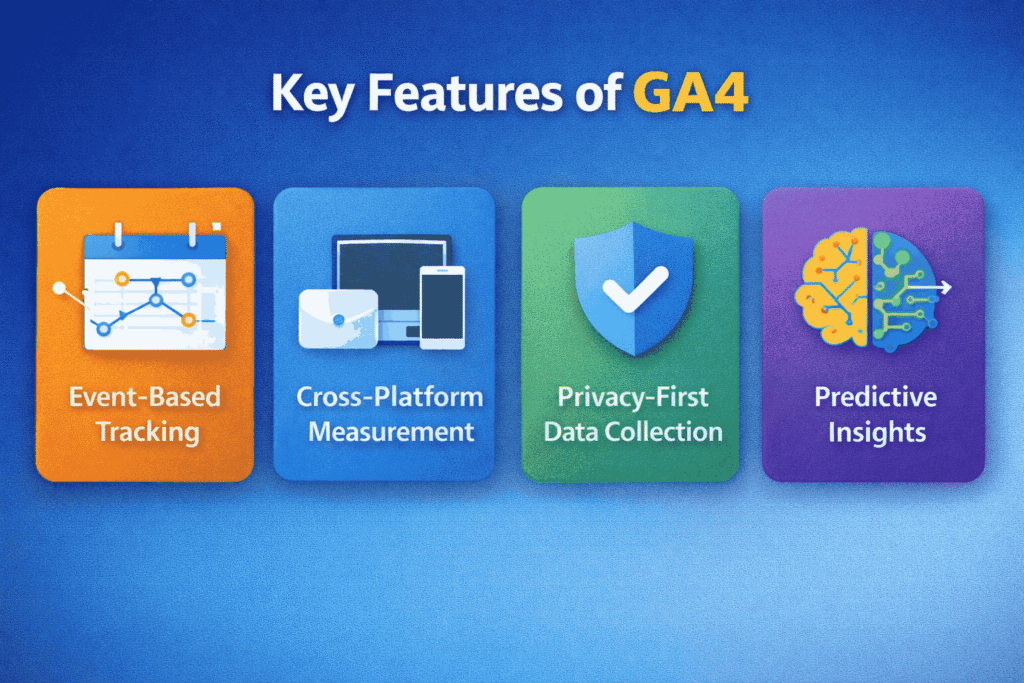
GA4 offers several powerful features that make it suitable for modern marketing. Its event-based tracking allows greater flexibility and deeper insights into user behavior. Enhanced measurement automatically tracks common interactions like scrolls, outbound clicks, site searches, and file downloads without extra setup.
GA4 also includes AI-powered insights and predictive metrics, such as purchase probability and churn prediction. Built-in privacy controls help businesses comply with regulations like GDPR and CCPA. One of GA4’s most powerful capabilities is its use of AI-powered marketing insights, which help predict user behavior, identify trends, and improve marketing strategies.
How GA4 Works (Simple Explanation)
In GA4, everything is tracked as an event. Each event can include parameters that provide additional context, such as page location, button text, or transaction value. User properties store long-term attributes like location or device type.
Instead of focusing on sessions and bounce rates, GA4 emphasizes engagement, events, and user journeys, giving a more realistic view of how users interact with your brand.
GA4 vs Universal Analytics
Universal Analytics focused on sessions and page views, while GA4 focused on users and events. UA reports were static and limited, whereas GA4 offers flexible exploration reports and funnels.
GA4 also provides better attribution modeling, cross-platform tracking, and future readiness. Universal Analytics is no longer supported, making GA4 the only viable option moving forward.
Why GA4 Is Important for Modern Digital Marketing
Modern digital marketing requires accurate, cross-channel insights. GA4 helps marketers understand how users interact with content, ads, and products across platforms. It supports data-driven decisions by providing deeper behavioral insights.
GA4 also aligns with privacy-first marketing strategies, ensuring businesses can continue tracking performance while respecting user consent and regulatory requirements. GA4 plays a critical role in data-driven marketing by enabling businesses to make informed decisions based on real user behavior rather than assumptions or incomplete data.
Benefits of GA4 for Marketers
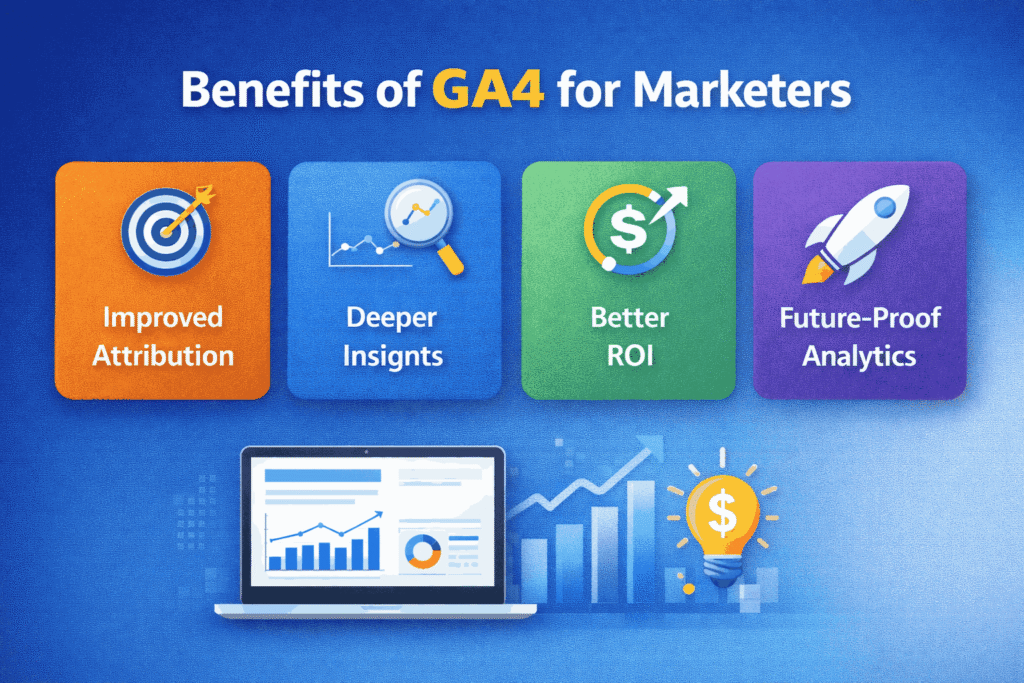
GA4 improves campaign optimization by offering clearer visibility into what drives engagement and conversions. Marketers can analyze full customer journeys instead of isolated touchpoints.
Predictive analytics help anticipate user behavior, while seamless integration with Google Ads and BigQuery allows advanced analysis and better ROI tracking. With GA4, marketers can focus on measuring campaign success more accurately by tracking conversions, engagement metrics, and performance across multiple channels.
GA4 Use Cases in Digital Marketing
For SEO, GA4 tracks organic traffic engagement, scroll depth, and conversions more effectively. For PPC, it improves attribution and audience insights. Ecommerce businesses benefit from enhanced funnel tracking and purchase behavior analysis.
Content marketers can measure real engagement, not just page views, while growth marketers can build data-driven strategies using explorations and custom reports. GA4’s detailed engagement metrics also support featured snippet optimization by helping identify content that delivers strong user interaction and satisfaction.
Common Challenges When Using GA4
GA4 has a learning curve, especially for users familiar with Universal Analytics. Default reports are limited, requiring customization. Some metrics differ from UA, which can initially cause confusion.
However, once properly configured, GA4 provides far more actionable insights than previous analytics tools.
How to Get Started With GA4
To get started, create a GA4 property in Google Analytics and connect it to your website or app. Enable enhanced measurement, set up key events, and mark important events as conversions.
Integrate GA4 with Google Ads and Search Console for complete performance tracking. Regularly review data and refine event tracking to match business goals.
Is GA4 Mandatory?
Yes. Universal Analytics has been fully sunset, meaning it no longer collects data. Businesses that do not use GA4 risk losing critical performance insights.
GA4 is now the standard analytics solution for all websites and apps using Google Analytics.
Best Practices for Using GA4 Effectively
Define clear goals and track only meaningful events. Use explorations for funnels, paths, and cohort analysis. Regularly audit data accuracy and event configurations.
Focus on insights, not just data. GA4 is most powerful when used to guide strategic decisions.
Final Thoughts
GA4 is not just an update it is a complete shift in how analytics works. It reflects modern user behavior, privacy standards, and marketing needs. Businesses and marketers who adapt to GA4 early gain a competitive advantage.
If you want accurate insights, smarter campaigns, and future-proof analytics, GA4 is essential for modern digital marketing.
FAQs
GA4 (Google Analytics 4) is Google’s latest analytics platform that tracks user behavior using events instead of sessions. It helps businesses understand how users interact across websites and apps.
Google replaced Universal Analytics to adapt to privacy changes, reduced cookie tracking, and multi-device user behavior. GA4 offers better cross-platform tracking and future-ready measurement.
Yes, GA4 is mandatory because Universal Analytics no longer collects data. Any website using Google Analytics must switch to GA4 to continue tracking performance.
Yes, GA4 is very useful for SEO and digital marketing. It provides deeper insights into user engagement, conversions, traffic sources, and customer journeys.
Yes, GA4 is completely free to use. Advanced users can also connect GA4 with BigQuery for deeper data analysis at an additional cost.