
Search engines have evolved far beyond simple keyword matching. In 2025, Google prioritizes topical authority, semantic relevance, and user intent, making traditional one-keyword-per-page strategies far less effective. This shift has made content clustering one of the most powerful SEO strategies for achieving higher and more stable search rankings.
Content clustering helps websites organize information around core topics, making it easier for search engines to understand expertise while guiding users through related content seamlessly.
What Is Content Clustering?
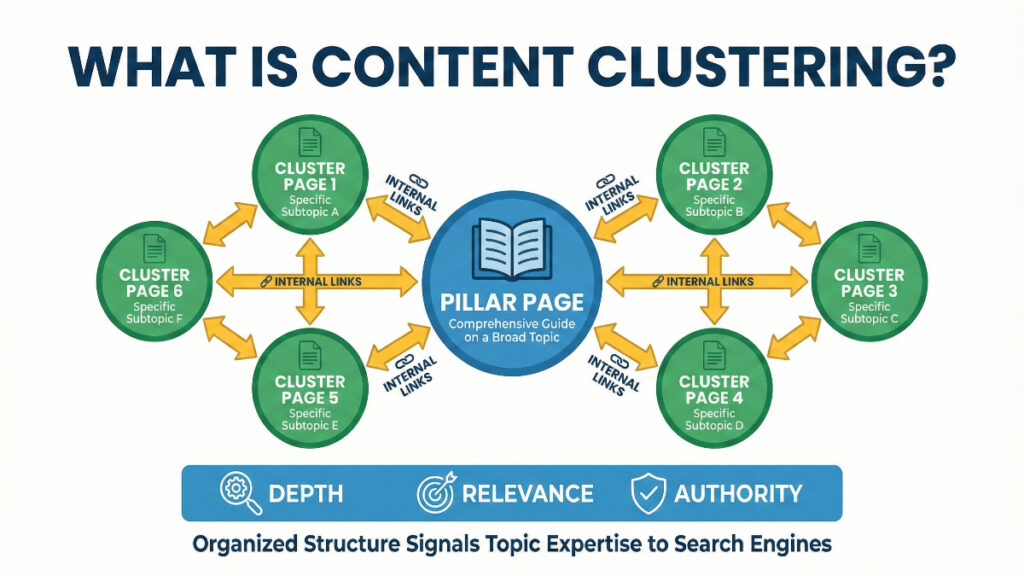
Content clustering is an SEO strategy where content is organized into topic-based groups rather than isolated articles. Each cluster consists of:
A Pillar Page – a comprehensive guide covering a broad topic
Cluster Pages – supporting articles targeting specific subtopics
Internal Links – connecting all cluster pages back to the pillar and vice versa
This structure signals to search engines that your website has depth, relevance, and authority on a given topic.
To fully grasp its role in modern SEO, it helps to understand the foundations of optimization. This SEO starter guide breaks down how on-page, off-page, and structural SEO work together.
Why Content Clustering Improves Search Rankings
Content clustering works because it aligns with how modern search engines evaluate content. From an implementation standpoint, this strategy works best when paired with strong technical SEO foundations such as crawlability, internal link flow, and site structure. That’s why understanding why technical SEO is important is essential when building scalable content clusters.
Key SEO Benefits
Improves crawlability and indexation
Builds topical authority
Reduces keyword cannibalization
Increases time on site and user engagement
Strengthens E-E-A-T (Experience, Expertise, Authority, Trust)
Instead of ranking one page for one keyword, clusters allow your site to rank for dozens or hundreds of related queries.
Content Clustering vs Traditional SEO
| Traditional SEO | Content Clustering |
| Focuses on single keywords | Focuses on topics |
| Standalone blog posts | Interconnected content |
| Limited authority signals | Strong topical authority |
| Higher cannibalization risk | Clear keyword hierarchy |
Google now rewards websites that demonstrate subject mastery, not just keyword usage.
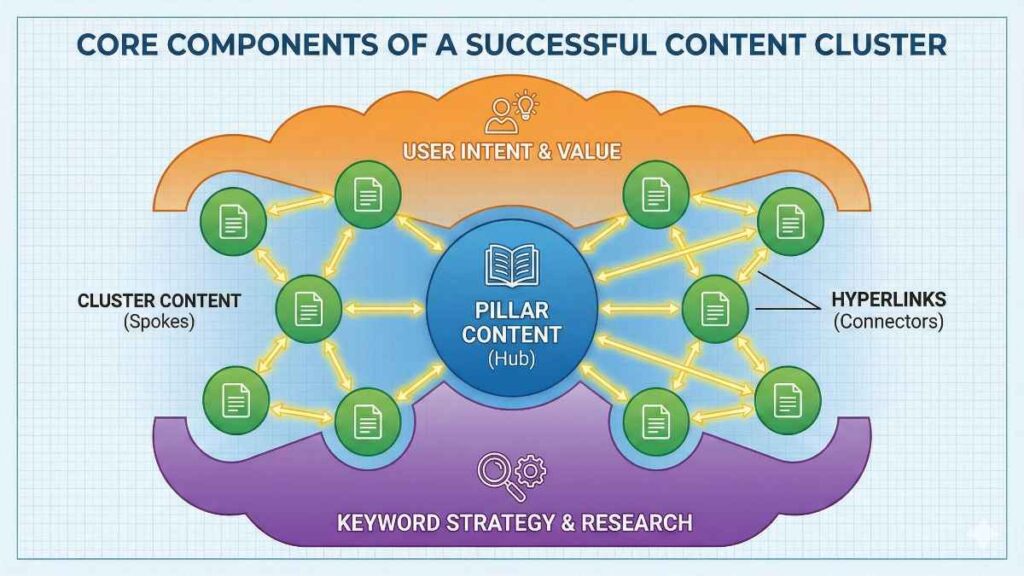
Core Components of a Successful Content Cluster
1. Pillar Content
A pillar page is a long, authoritative resource that broadly covers a topic.
Best Practices:
2,000–4,000 words
Targets high-volume keywords
Covers all major subtopics
Acts as the central linking hub
2. Cluster Content
Cluster pages dive deeper into individual subtopics.
Examples:
“Content Clustering Tools”
“Internal Linking Best Practices”
“Common Content Clustering Mistakes”
Each cluster page targets long-tail and semantic keywords.
3. Internal Linking Structure
Cluster pages link to the pillar
Pillar links back to all clusters
Use descriptive, keyword-rich anchor text
Avoid excessive or forced links
How to Build a Content Clustering Strategy (Step by Step)
Step 1: Identify Core Topics
Choose topics that:
Are central to your business or niche
Have long-term search demand
Can support multiple subtopics
Step 2: Perform Topic-Based Keyword Research
Group keywords by search intent, not just volume.
Types to include:
Informational
Navigational
Commercial
Transactional
Step 3: Map Keywords to Pillar and Cluster Pages
Assign:
Broad keywords → pillar pages
Specific queries → cluster pages
This prevents keyword overlap and cannibalization.
Step 4: Create the Pillar Page First
Publish a high-quality pillar before cluster articles so internal links are live immediately.
Step 5: Publish Supporting Cluster Content
Release cluster articles consistently to strengthen authority.
Step 6: Add Strategic Internal Links
Link naturally and logically—avoid over-optimization.
Keyword Research for Content Clusters
Effective cluster keyword research goes beyond tools.
Best Sources
Google autocomplete
“People Also Ask”
Related searches
Search Console data
Competitor content gaps
Focus on semantic relevance, not exact-match repetition.
Optimizing Content Clusters for SEO
On-Page SEO
One clear H1 per page
Logical H2–H3 hierarchy
Optimized meta titles and descriptions
Natural keyword placement
Technical SEO
Fast page load speed
Mobile optimization
Clean URL structure
Proper indexation
Schema Markup
FAQ schema for cluster pages
Article schema for pillar pages
Content Clustering and User Experience (UX)
Clusters improve UX by:
Creating clear learning paths
Reducing bounce rate
Increasing session duration
Helping users find answers faster
Better UX = stronger ranking signals.
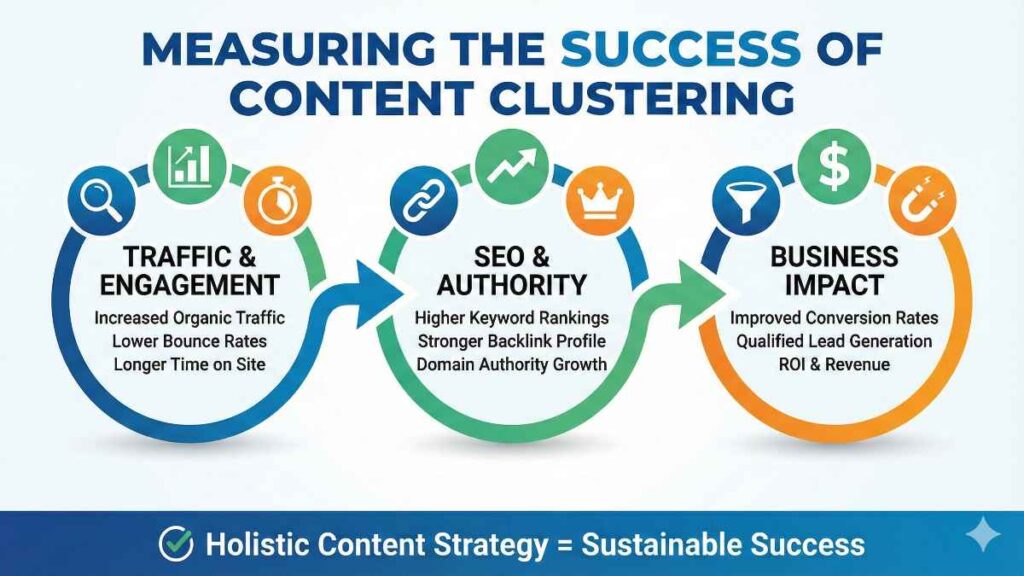
Measuring the Success of Content Clustering
Key Metrics to Track
Organic traffic growth
Keyword ranking distribution
Topical authority expansion
Internal link clicks
Engagement metrics
Expected Timeline
1–2 months: Indexation improvements
3–6 months: Ranking growth
6+ months: Authority dominance
Common Content Clustering Mistakes to Avoid
Creating thin pillar pages
Ignoring search intent
Poor internal linking
Overlapping keywords
Publishing clusters without strategy
Advanced Content Clustering Techniques
Updating and expanding existing clusters
Pruning outdated or low-value pages
Interlinking related clusters
Scaling clusters across categories
Large websites benefit most from interconnected topic ecosystems.
Content Clustering for Different Website Types
Blogs
Build authority and long-term organic traffic.
Service Websites
Rank for commercial and local keywords.
E-commerce
Support product pages with informational clusters.
Local SEO
Create clusters around services + locations.
Content Clustering in the Age of AI Search (2025+)
AI-powered search favors:
Context
Topical depth
Structured content
Clear expertise signals
Content clustering future-proofs your SEO against algorithm changes, SGE, and AI-driven answers.
Conclusion
Content clustering is no longer optional; it’s a core SEO strategy for sustainable growth. By organizing content around topics instead of isolated keywords, you build authority, improve rankings, and deliver better user experiences.
Websites that master content clustering don’t just rank higher they own their niche.